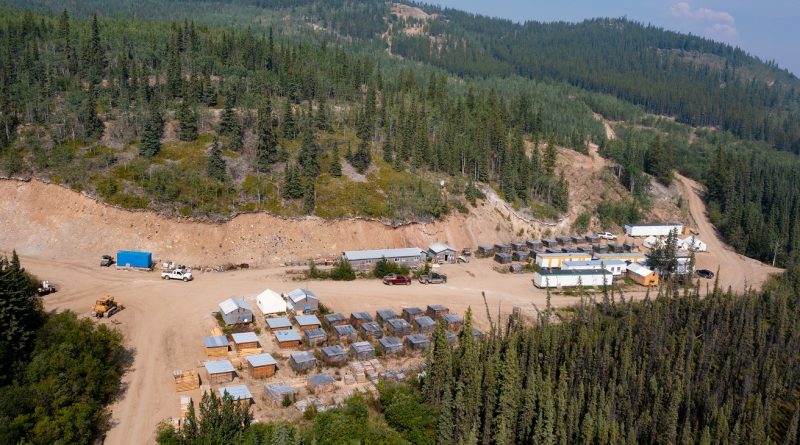
Cascadia ramps up biggest Carmacks drill campaign in 19 years
Subscribe to our free newsletter today to keep up to date with the latest mining and minerals news.
Cascadia Minerals is launching its largest exploration campaign at the Carmacks copper-gold project in nearly two decades, marking a major escalation in activity at one of Yukon’s better-known undeveloped copper assets.
The company’s 15,000-meter diamond drilling program is designed to test both resource expansion opportunities and new regional targets across a large land package in the Minto Copper Belt. The scale of the campaign reflects growing confidence in the project’s sulphide potential and arrives as global copper demand forecasts continue to strengthen.
Copper exploration companies have spent much of the past several years repositioning around electrification, grid expansion and long-term supply concerns. Carmacks sits directly within that broader shift, offering a combination of existing resources, road access and district-scale exploration potential in a stable Canadian jurisdiction.
Cascadia is shifting Carmacks from historical asset to growth-stage copper project
Carmacks has long been recognized within Yukon’s mining sector, though activity at the project remained relatively subdued for years following earlier development studies focused largely on oxide mineralization.
Cascadia’s current strategy places greater emphasis on sulphide mineralization, which the company believes could support stronger long-term economics and larger-scale development potential.
The project currently hosts a measured and indicated resource of 36.3 million tonnes grading 0.81% copper and 0.26 grams per tonne gold. That resource contains approximately 651 million pounds of copper and 302,000 ounces of gold.
The company now appears focused on demonstrating that the broader mineralized system extends beyond the historically defined resource areas.
Recent drilling has supported that thesis. Intercepts released over the past year include 83.52 meters grading 0.89% copper and 0.26 g/t gold, alongside 87.44 meters grading 0.63% copper and 0.15 g/t gold. Another interval returned 60.12 meters grading 0.84% copper and 0.16 g/t gold.
Management has highlighted the continuity of sulphide mineralization as one of the most important aspects of the evolving geological model. Investors increasingly favor copper projects capable of supporting larger and longer-life operations, particularly in politically stable jurisdictions where infrastructure risks are lower.
Road access remains one of Carmacks’ practical advantages. Northern exploration projects often face substantial logistical challenges tied to seasonal access and infrastructure limitations. Carmacks benefits from proximity to existing transportation routes and nearby infrastructure, reducing some of the development hurdles commonly associated with remote Canadian projects.
The location within the Minto Copper Belt also adds geological credibility. The district has already demonstrated its ability to host economic copper deposits, giving explorers a clearer framework for targeting additional mineralization.
New drilling targets could reshape the scale of the Carmacks system
The 2026 campaign extends beyond infill drilling around known zones. Cascadia is also stepping outward into less-tested targets that could materially expand the scale of the overall system.
Several of the company’s priority targets sit adjacent to existing mineralization, including the Gap Zone and Sourtoe areas. These zones are viewed as important because they may help establish broader connectivity between known deposits and emerging targets.
Zone 147, 2000S and 1213 have also become increasingly important within the exploration narrative. Results from these areas suggest the mineralized footprint may be more extensive than earlier interpretations indicated.
The company’s broader land package spans roughly 180 square kilometers, leaving substantial room for regional discoveries outside the current resource footprint.
That district-scale opportunity has become more valuable as major mining companies and investors search for copper projects capable of meaningful long-term production growth. Smaller isolated deposits often struggle to attract development capital unless they can demonstrate expansion potential or operational scalability.
Sulphide continuity is likely to remain a central focus throughout the current campaign. In copper systems, continuity can influence both future mine planning and processing economics. Projects with larger sulphide inventories are frequently viewed as stronger long-term candidates because they may support more conventional milling operations and longer mine lives.
Cascadia’s exploration strategy suggests the company is attempting to reposition Carmacks from a relatively contained historical project into a broader district-scale copper story.
Copper market fundamentals are creating a stronger backdrop for Yukon explorers
The timing of the program aligns with improving sentiment across the global copper sector.
Copper demand projections tied to electrification, renewable energy infrastructure and transmission upgrades continue to support expectations for future supply deficits. Major miners and governments alike have increasingly classified copper as a strategically important material tied to industrial policy and energy security.
That shift has created renewed interest in North American copper projects, particularly those located in jurisdictions with established permitting systems and lower geopolitical risk.
Canada has become an increasingly important part of that conversation. Federal and territorial governments continue to position critical mineral development as an economic priority, while investors remain focused on projects that could eventually contribute to domestic or allied supply chains.
Junior explorers such as Cascadia still face the usual challenges tied to financing, permitting and technical advancement. Yet market conditions appear considerably more supportive than they were during previous commodity downturns.
For Carmacks, the next phase will likely depend on whether current drilling can successfully expand the known mineralized footprint and support future engineering work. Updated economic studies, additional metallurgical testing and resource expansion drilling are expected to remain key milestones.
The 2026 campaign may ultimately determine whether Carmacks evolves into a more advanced development project or remains an earlier-stage exploration story. For now, the scale of the drilling program signals that Cascadia believes the project’s next chapter could be materially larger than its past.
Source
Photo credit