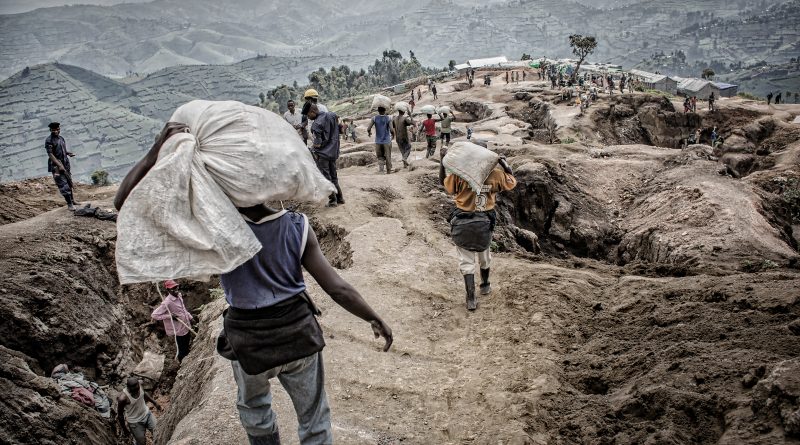
Congo is using a paramilitary force to secure critical mineral supply chains
Subscribe to our free newsletter today to keep up to date with the latest mining and minerals news.
The Democratic Republic of Congo is moving to create a specialized force tasked with protecting strategic mining assets, a decision that highlights how critical minerals have become central to geopolitical competition, industrial policy and global supply chain planning.
The proposed mining guard arrives at a moment when governments and manufacturers are trying to secure long-term access to cobalt, coltan, copper and tantalum, all of which are essential to batteries, semiconductors, electric vehicles and defense technologies. Congo already occupies an outsized position in that ecosystem. The country holds some of the world’s largest reserves of critical minerals and remains a dominant producer of cobalt and coltan, materials deeply embedded in modern electronics manufacturing.
Kinshasa’s latest move also reflects a broader shift in how resource-rich states are approaching security. Mineral supply chains are no longer viewed purely as commercial infrastructure. They are increasingly treated as strategic national assets tied directly to industrial resilience and geopolitical leverage.
At the same time, eastern Congo continues to face persistent instability linked to armed groups operating near some of the country’s most valuable mining regions. That insecurity has created concerns among investors, technology companies and Western governments trying to diversify mineral sourcing away from China-dominated processing networks.
How Congo became indispensable to the modern technology economy
Congo’s importance within global supply chains has expanded sharply over the past decade as governments accelerated investments in electrification, artificial intelligence infrastructure and defense manufacturing.
The country produces a substantial share of the world’s cobalt supply and roughly 40% of global coltan output, according to recent reporting. Coltan is refined into tantalum, a metal used in smartphones, aerospace systems and advanced computing hardware. Cobalt remains essential for many battery chemistries powering electric vehicles and energy storage systems.
That concentration has transformed Congo from a regional mining economy into one of the most strategically important resource markets in the world.
Washington, Brussels and several Gulf states have intensified diplomatic and financial engagement across Africa as concern grows over China’s long-standing influence across mining extraction and mineral processing. Chinese firms have spent years building dominant positions in Congolese mining infrastructure, refining operations and transportation corridors, giving Beijing considerable leverage across global supply chains.
For Western policymakers, reducing dependence on Chinese-controlled mineral networks has become a central industrial objective. That effort has accelerated following supply chain disruptions during the pandemic and rising tensions surrounding trade, technology restrictions and semiconductor access.
The result is a new contest over mineral access that increasingly resembles traditional geopolitical competition once associated with oil and natural gas.
Conflict in eastern Congo continues to destabilize supply chains
Despite Congo’s mineral wealth, large sections of the eastern region remain deeply unstable. Armed groups continue to compete for territorial control, smuggling routes and mining revenues.
Among the most prominent is the M23 rebel movement, which Congolese authorities and several international observers have linked to support from neighboring Rwanda, allegations Kigali denies. Fighting has displaced millions of civilians and repeatedly disrupted commercial activity near mining zones.
For multinational corporations and commodity traders, insecurity introduces operational risk across every stage of the supply chain. Transport corridors can become inaccessible, mining operations may temporarily shut down and illicit mineral trafficking can distort official export figures.
Analysts have warned for years that conflict minerals continue to enter international markets through opaque trading networks that route materials through neighboring countries before export. Those concerns have pushed governments and manufacturers to impose stricter due diligence standards on sourcing practices.
Yet enforcing transparency remains difficult in regions where state authority is limited and armed groups retain influence over transportation and extraction sites.
The emergence of critical minerals as strategic assets has only intensified scrutiny on Congo’s ability to secure production and stabilize mining operations.
Congo’s mining guard reflects a broader geopolitical realignment
The proposed mining force is expected to eventually include more than 20,000 personnel and has reportedly received support linked to US and UAE interests.
While Congolese authorities present the initiative primarily as a domestic security measure, the international implications are difficult to ignore. Governments seeking stable mineral access increasingly recognize that securing supply chains may require direct engagement with local security frameworks, infrastructure projects and regional diplomacy.
The US has steadily expanded efforts to strengthen partnerships across Africa’s mining sector as part of a broader strategy aimed at reducing strategic vulnerabilities tied to China’s dominance in mineral refining.
That approach differs from previous decades when Western engagement with African resource economies was often driven largely by private sector investment. Today, mineral access is being discussed within the language of national security, industrial competitiveness and technological sovereignty.
The UAE has also emerged as an increasingly influential player across African commodity markets, investing heavily in logistics, ports and mineral trading infrastructure. Gulf states view critical minerals as a long-term growth sector tied to energy transition technologies and advanced manufacturing.
Still, skepticism remains around whether a mining-focused security force can resolve the deeper structural problems affecting Congo’s resource economy.
Critics argue that militarization alone cannot address corruption, weak institutions or illegal extraction networks that have operated for decades. Others warn that expanding security operations around mining zones could create additional governance risks if oversight mechanisms remain limited.
Congo’s next challenge is turning strategic importance into economic stability
Congo’s mineral wealth has historically failed to translate into broad-based economic development. Infrastructure deficits, political instability and corruption have repeatedly limited the state’s ability to capture long-term value from its natural resources.
That history continues to shape investor perceptions.
International mining companies and foreign governments may support stronger security protections around extraction sites, but many will also look for evidence of regulatory consistency, transparent licensing systems and functioning transportation infrastructure.
For Congo, the opportunity is enormous. Global demand for critical minerals is expected to remain elevated for years as governments pursue electrification targets and technology companies expand AI-related infrastructure requiring massive quantities of raw materials and processed metals.
The challenge is whether Kinshasa can move beyond simply supplying raw materials and instead position itself as a more stable and influential player within global industrial supply chains.
The answer will likely shape not only Congo’s economic trajectory, but also the balance of influence across the rapidly evolving global minerals economy.
Source