New study from the University of Michigan examines whether North America can mine enough rare earth elements
A new University of Michigan (U-M) study finds that North America holds enough rare earth element deposits to meet domestic demand for decades – but targeted government support is essential to bring the right sites into production.
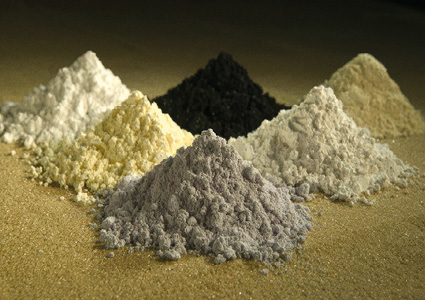
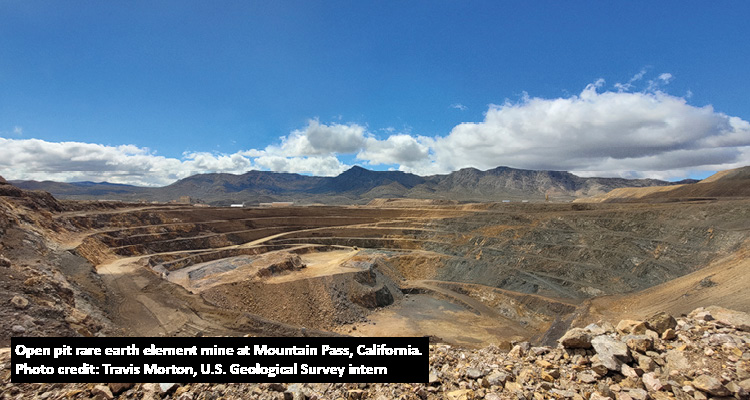
Photo credit: Geological Survey intern
Rare earth elements sit at the heart of modern technology. From the magnets in wind turbines and battery electric vehicles to the components inside smartphones and flat-screen televisions, these minerals underpin both everyday life and the clean energy transition. Roughly half of all rare earth elements mined today go into magnets used across industries, from aerospace and defense to renewable energy.
Led by U-M scientists Stephen Kesler, Professor Emeritus in the Department of Earth and Environmental Sciences, and Greg Keoleian, Professor of Sustainable Systems at U-M’s School for Environment and Sustainability, the study evaluates 28 sites across North America against global benchmarks to determine which deposits are commercially viable. Other co-authors include Christian Hitt and Jacob Cieply of U-M Center for Sustainable Systems, and Hyung Chul Kim, Robert DeKleine and James Anderson of Ford Motor Company’s Research and Innovation Center.
Supply and demand
The urgency is clear. In the study, Stephen and Greg estimate that worldwide demand for rare earth minerals will rise from 91 kilotons in 2024 to 123 kilotons in 2030 and 150 kilotons in 2040. Yet the US currently accounts for around 11 percent of global rare earth element mining, while China controls approximately 70 percent.
That imbalance is the central problem the study addresses. With supply chains under growing geopolitical scrutiny and rare earth elements classified as critical minerals by the US government, the pressure to develop domestic production has never been greater.
“One reason rare earth elements are classified as critical minerals is because of their vital importance for multiple industrial and technology applications as well as national defense,” says Greg. “But they also pose a supply chain risk, and disruption of the supply chain could have significant economic and national security consequences. And they’re essential inputs for the clean energy transition.”
Making the grade
To assess North America’s potential, the researchers examine tonnage, grade, and total rare earth oxide content at each of the 28 sites. Tonnage refers to how much rare earth-bearing rock sits in the ground; grade refers to the concentration of target elements within that rock. The team also evaluates the presence of complicating minerals; thorium, a radioactive element frequently found alongside rare earths, adds significant disposal costs and directly affects a site’s economic viability.
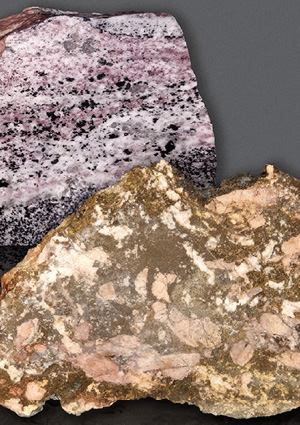
Photo credit: Philip Verplanck, U.S. Geological Survey
The findings are broadly positive, though not without caveats. Apart from the Mountain Pass mine in California (the only site currently in operation), North American deposits are of lower quality than those operating in China and Australia. However, Stephen argues the gap is narrow enough to bridge.
“The bottom line is that the deposits are close enough in quality that they might be able to support a domestic supply chain with a little government support, particularly if prices remain high,” he explains. “The increased costs of mining rare earths in a supply chain of this type might be offset by savings in other parts of the processing and manufacturing stages.”
Light and heavy
Rare earth elements fall into two broad categories: light rare earth elements and heavy rare earth elements. Light rare earths are more abundant and feature across a wide range of products; they also carry strong magnetic properties. Heavy rare earths, while less common, are valuable because they improve magnet stability at high temperatures, which is a critical requirement for electric vehicle motors and wind turbines operating in demanding environments.
The study finds a clear geographic divide across the continent. US deposits contain predominantly light rare earth elements, while heavy rare earth deposits concentrate in Canada. “For light rare earths, the US could do a good job of supplying itself, and for heavy rare earths, we would do best to co-operate with Canada,” says Stephen.
A measured path
The researchers carefully note that more mining is not automatically better. Oversupply drives prices down, pushing producers out of business and undermining any nascent domestic industry before it takes hold. The study, supported by Ford Motor Company, advocates a measured, government-guided approach to developing North American production.
“With this study, we are trying to give a framework of information that might allow a more systematic evaluation of deposits, and to avoid an overconcentration of support for deposits which might not, in the long run, be competitive,” Stephen notes. “Environmentally, we don’t want to do any more mining than necessary.”
Beyond mining, the researchers emphasize building a fully integrated processing infrastructure within North America. Previously, rare earth elements mined in the US were exported to China for processing – a dependency the current study is designed to help reverse.
Next, the team plan to examine whether domestic rare earth supply can meet demand for electric vehicles and other applications through 2050, focusing on the processing and recovery rates of four key magnet elements: neodymium, praseodymium, dysprosium, and terbium.
Read the full study at sciencedirect.com
Researchers and authors include Stephen Kesler, Professor Emeritus in the Department of Earth and Environmental Sciences; Greg Keoleian, Professor of Sustainable Systems at U-M’s School for Environment and Sustainability; Christian Hitt and Jacob Cieply of U-M Center for Sustainable Systems; Hyung Chul Kim, Robert DeKleine, and James Anderson of Ford Motor Company’s Research and Innovation Center.