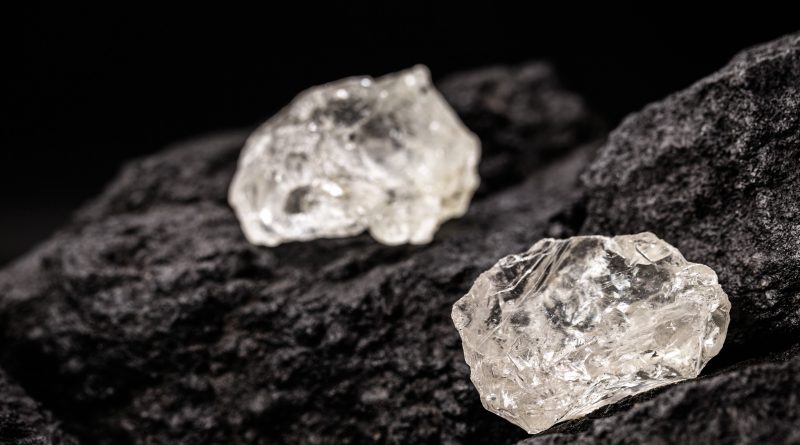
Scientists uncover the deep-Earth origin of the world’s largest diamonds
Subscribe to our free newsletter today to keep up to date with the latest mining and minerals news.
The world’s largest and most valuable diamonds have puzzled scientists for decades. Known as CLIPPIR diamonds, an acronym describing their large, pure and irregular characteristics, these rare gems include some of the most famous diamonds ever discovered, including the Cullinan Diamond.
Now, researchers led by the University of Cape Town have identified new evidence pointing to how and where these extraordinary stones formed deep within Earth’s mantle.
Published in Nature Communications, the study examined the chemistry of olivine minerals carried to the surface by kimberlite eruptions. The findings suggest that CLIPPIR diamonds formed in iron-rich regions more than 150 kilometers beneath continents, in environments shaped by ancient oceanic crust recycled into Earth’s interior.
The research was conducted by the Kimberlite Research Group at UCT’s Department of Geological Sciences in collaboration with the Carnegie Institution for Science in Washington and the China University of Geosciences in Beijing.
Kimberlite eruptions are offering scientists a direct glimpse into Earth’s mantle
Kimberlites are volcanic rocks that originate deep inside the mantle and erupt rapidly toward the surface. These eruptions are among the only natural mechanisms capable of transporting diamonds and deep mantle minerals intact.
For geologists, kimberlites provide a rare opportunity to investigate regions of Earth otherwise inaccessible to direct observation.
The UCT-led study focused on olivine, a green mineral commonly found in mantle rocks and kimberlites. By analyzing isotopic signatures preserved within olivine crystals, researchers reconstructed the chemical environment in which CLIPPIR-bearing kimberlites formed.
The team found a consistent pattern among kimberlites carrying large gem-quality diamonds. Their olivine chemistry revealed unusually iron-rich mantle domains marked by light oxygen isotopes and heavy iron isotopes.
Those signatures are widely associated with hydrothermally altered oceanic crust, material that originally formed at the seafloor before being dragged deep into Earth through tectonic subduction.
According to Associate Professor Geoffrey Howarth, lead author of the study, these ancient crustal fragments later accumulated at the base of continental lithosphere through mantle upwelling processes.
“These extraordinary diamonds have long been a mystery,” Howarth said.
“Our study shows that they grew in an unusual iron-rich environment deep beneath the continents, formed from ancient oceanic crust that was dragged down by subduction and then accreted at the base of the lithosphere.”
Ancient oceanic crust may have created the conditions for giant diamond growth
The study proposes that interaction between rising kimberlitic melts and iron-rich mantle domains generated the large olivine and garnet megacrysts commonly associated with CLIPPIR-bearing kimberlites.
At the same time, the diamonds themselves likely crystallized under extreme pressures exceeding 11 gigapascals inside the mantle transition zone, a region separating Earth’s upper and lower mantle.
That depth places their formation environment hundreds of kilometers below the surface, far deeper than most conventional diamond formation models.
The findings also suggest that these chemically unusual mantle regions are not isolated anomalies. Instead, they may represent an important and widespread component of Earth’s mantle architecture.
Researchers believe the same iron-rich domains could influence the chemistry of volcanic rocks erupted around the world, providing fresh insight into how Earth recycles crustal material over geological time.
The implications extend beyond academic geology. By identifying the chemical fingerprints linked to CLIPPIR diamond formation, the study could help guide future exploration strategies for high-value diamond deposits.
Howarth said the mineral chemistry preserved within kimberlites now provides researchers with a clearer framework for identifying environments capable of producing exceptional diamonds.
“By reading the chemical fingerprints preserved in the mineral olivine brought up by kimberlite eruptions, we can now trace where these exceptional diamonds come from and how to find more of them,” he said.
The research also reinforces a broader scientific shift toward viewing Earth’s deep interior as a dynamic recycling system, where ancient oceanic crust can survive for billions of years before contributing to new geological processes far beneath continents.
Rather than forming in isolated pockets, the planet’s largest diamonds may ultimately be the product of tectonic recycling on a planetary scale, linking the deep mantle to ancient ocean floors in ways scientists are only beginning to understand.
Source