Texas Aggregate Mining Equipment Buyers Guide: Sourcing Loaders, Trucks, and Crushers as Production Hits Record Levels in 2026
Texas aggregate operators face unprecedented demand heading into 2027, driven by a production surge in 2026. Selecting the right loaders, haul trucks and crushers requires matching specs, evaluating tonnage targets and more.
The State of Texas Aggregate Production
U.S. output of construction aggregates in the first quarter of 2026 increased 6%, to about 481 million metric tons. Texas ranks as the leading state for aggregate production and crushed stone output. This boom forces operators to scale up quickly as the state assesses its remaining natural resources.
The leading industry magazine, Pit & Quarry, takes note. “Texas is taking an unprecedented look at precisely where the state’s natural resources are most abundant with legislation that encompasses four components: resource mapping, land-use analysis, public database access and legislative reporting,” says writer Andrew Pinkerton.
| 💡QUICK ANSWER: Where to Buy Heavy Equipment for Mining Operations in Texas Texas mining operators source heavy equipment through authorized Cat dealers and regional equipment suppliers with established service networks across the state. According to Warren CAT, when selecting an equipment provider, evaluate three critical capabilities: Parts inventory depth and distribution coverage, Field service response times and mobile technician availability, andRental fleet options for temporary scaling needs. Authorized dealerships typically maintain regional parts warehouses, offer after-hours parts access through drop boxes, and provide mobile service coverage across West Texas, Central Texas, and Gulf Coast regions. For aggregate operations specifically, prioritize dealers that carry wheel loaders, articulated haul trucks, and crushing equipment sized for Texas geology (limestone, sandstone, sand/gravel) and can match equipment specifications to your daily tonnage targets and site conditions. |
Evaluating Dealer Capabilities in Texas
Acquiring the right machinery requires a robust logistical partner. Operators must evaluate dealer networks to ensure investments receive support from expansive inventory and rapid service response.
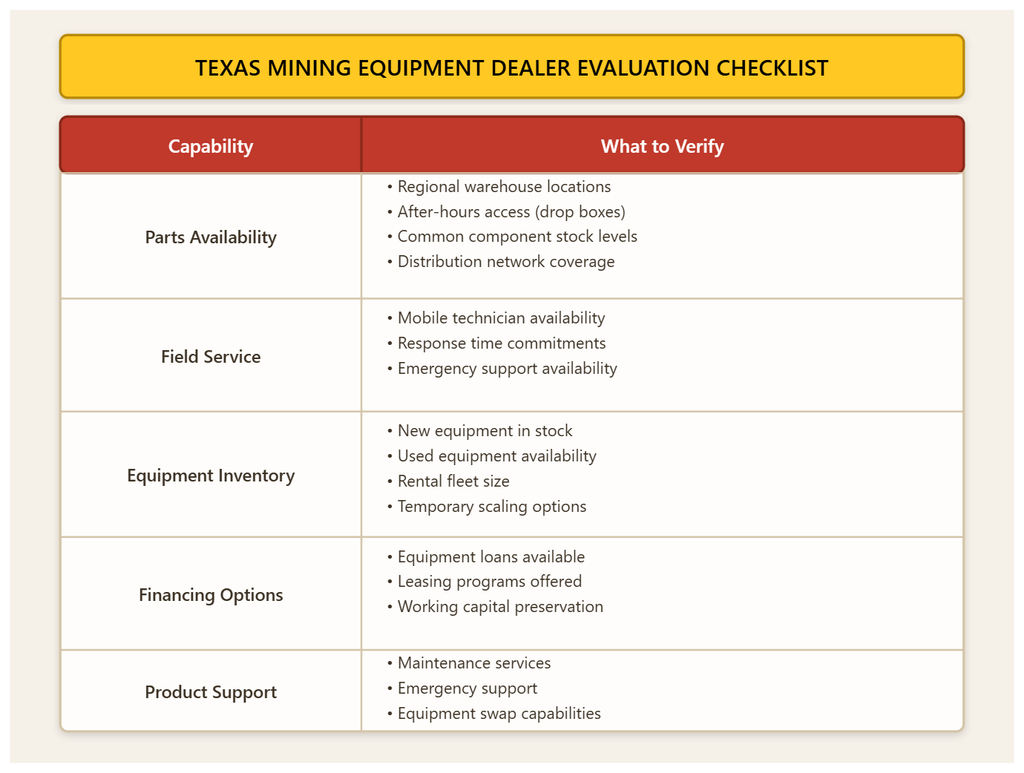
- Assessing Parts Availability and Field Service
Dealers that provide parts and field service minimize downtime when equipment failures threaten production. Operators should evaluate parts inventory depth, distribution network coverage and field service response times. Regional parts distribution and mobile service technicians can mean the difference between a two-hour repair and a two-day shutdown.
Dealers offering parts drop boxes provide after-hours access, while regional warehouses ensure common components remain in stock locally rather than requiring shipments from distant facilities.
- Exploring New Versus Used Equipment and Financing
Financial considerations shape every heavy machinery acquisition. Explore equipment financing options like traditional equipment loans. There’s also equipment leasing, which preserves capital for other operational needs while providing access to current technology. Rental programs offer the most flexibility for operations with fluctuating demand or temporary scaling requirements.
It’s also critical to compare the pros and cons of new and used mining equipment. New mining equipment is ideal for operations planning multiyear production commitments since it delivers long-term performance with minimal maintenance. Meanwhile, used equipment minimizes initial capital outlay while maintaining production flexibility.
Value for money should also be a priority. Warren CAT is an authorized Cat dealer that supplies multiple locations across West Texas with mining equipment and parts. It also provides product support to make the investment worthwhile.
“You get the quarry and aggregate equipment you need on demand with maintenance services, emergency support and the ability to swap out equipment based on your changing specifications while reducing the costs of owning and operating a large permanent fleet,” the company shares.
- Ensuring Emergency Rentals and Fast Replacements
Dealers with extensive rental fleets prove advantageous when unexpected gaps emerge or temporary scaling becomes necessary. The more uptime an operation maintains, the fewer financial losses it absorbs.
“Whether you rely on compactors, wheel loaders or rock-crushing equipment, you should be able to find everything you need in one place,” Warren CAT advises. “Choosing a dealer with a vast rental inventory saves you the hassle of visiting multiple dealerships.”
How to Select a Loader for Aggregate Operations
Loaders serve as the workhorses of quarry operations, requiring careful consideration of the environment and material characteristics.
Step 1: Assessing Texas Terrain Challenges
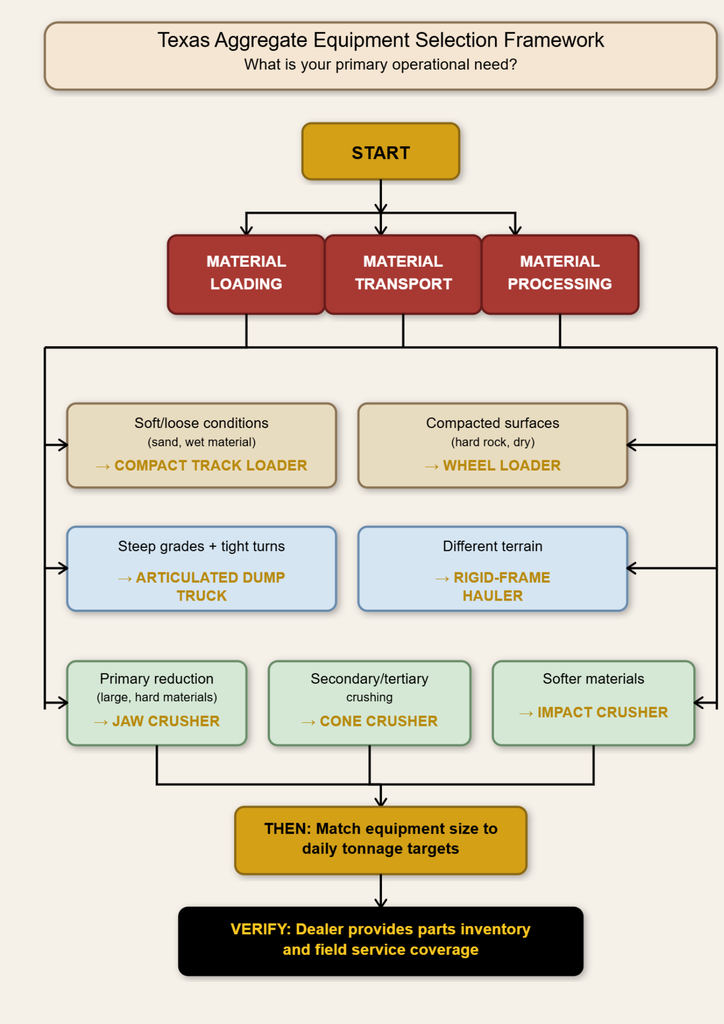
Site assessments should dictate whether operations opt for compact track loaders or traditional wheel loaders. Track loaders excel in soft conditions where flotation matters, while wheel loaders deliver superior speed on compacted surfaces.
Step 2: Evaluating Specific Material Characteristics
Material density and abrasiveness shape equipment selection. Loose sand behaves differently than jagged limestone, requiring different bucket configurations and hydraulic breakout force specifications.
Step 3: Matching Loader Capacity to Target Production
Open-pit operations typically require drill rigs, hydraulic excavators and wheel loaders. Underground mining benefits from compact loaders and rock dusters. Aligning loader size and engine power with daily output goals ensures efficient feeding of hoppers and crushers.
Comparing Haul Truck Capacity for Quarries
Haul trucks keep aggregate moving from extraction points to processing plants. That said, bigger isn’t always better if the site cannot support it — it’s vital to have additional guidelines.
Step 1: Calculating Precise Cycle Times
Measuring the time required for a truck to load, travel, dump and return reveals the actual number of trucks needed to maintain continuous material flow.
Step 2: Determining Ideal Payload Requirements
Matching truck payload to loader bucket size maximizes efficiency. The ideal configuration allows loaders to fill trucks in three to five passes.
Step 3: Evaluating Haul Road Conditions and Gradients
Steep inclines, sharp turns and road width determine whether operations need articulated dump trucks or rigid-frame haulers. Articulated trucks excel on steep grades and tight turns.
Matching Crushers and Material Handling Equipment
The right crushing and screening setup directly impacts product quality and throughput capacity. Curate a straightforward process to match the machinery with operational needs.
Step 1: Choosing the Right Crusher for Specific Rock Types
Jaw crushers handle primary reduction of large, hard materials. Cone crushers excel at secondary and tertiary crushing. Impact crushers work best for softer materials. Safety features and automated systems can adjust settings without shutting machines down.
Step 2: Designing Flexible Conveyor Systems for Aggregate Plants
Modular conveyor designs accommodate changing pit layouts as extraction zones shift. “You must choose machines for handling asphalt, concrete or aggregates with ease,” Warren CAT shares. “Consider the tools you’ll need to achieve the right surface texture and finish and the machines necessary for material handling applications and transport.”
Dom Corsetti from Sepro Systems, a mineral processing equipment provider, shared an experience with mobile conveyors. “We built 11 or 12 conveyors, a hundred feet long that were mobile on the port. And they were linked with electric cables. And so you could remove as you needed, or add as you needed.”
Essential Equipment Purchasing Framework
Here are the main factors operators must consider for their decisions ahead of 2027:
- Maintenance requirements: Assess service intervals, parts availability and technician response times to calculate costs.
- Operating costs: Factor fuel consumption, wear component replacement and operator training into total cost projections.
- Dealership logistics: Verify parts inventory depth, field service coverage and rental fleet availability.
- Material density: Match equipment specifications to actual material characteristics rather than generic tonnage ratings.
- Cycle time efficiency: Calculate precise load-haul-dump cycles to right-size fleets.
Frequently Asked Questions
Here are answers to common questions about aggregate equipment.
Should you buy new or used mining equipment for your operation?
New equipment suits long-term operations requiring minimal maintenance. Meanwhile, used equipment is better suited for short-term projects that need to minimize up-front investment.
What financing options are available for mining equipment?
Dealers typically offer equipment loans, leasing programs and rent-to-own arrangements. Leasing and rental options preserve working capital while providing access to equipment.
Which machines do you need for mine type and production target?
Open-pit sites need wheel loaders, haul trucks and crushers matched to rock hardness. Underground operations require compact equipment and ventilation systems. Daily tonnage targets dictate machine size and fleet quantity.
Can the dealer provide parts and field service for mining equipment?
Select dealers can provide parts and field service. Assess whether they can maintain local parts inventory, offer drop box access and deploy mobile technicians.
| 💡SUMMARY OF KEY TAKEAWAYS: Texas Aggregate Equipment Sourcing Texas aggregate production increased 6% in Q1 2026, with Texas remaining the #1 state for crushed stone output.Equipment dealers must provide three critical capabilities: parts inventory depth, field service coverage, and rental fleet availability.Loader selection depends on terrain (track vs. wheel), material characteristics (density/abrasiveness), and daily tonnage targets.Haul truck sizing requires calculating cycle times, matching payload to loader capacity (3-5 passes optimal), and evaluating haul road conditions.Crusher selection varies by application: jaw crushers for primary reduction of hard materials, cone crushers for secondary/tertiary crushing, and impact crushers for softer materials.New equipment suits long-term operations requiring minimal maintenance; used equipment minimizes up-front capital for short-term projects.Regional dealer coverage matters: verify parts warehouses, mobile technician availability, and after-hours parts access (drop boxes). |
Planning for Continued Production Growth in 2027
Meeting Texas aggregate market demands requires strategically matching equipment scale to specific environments. Securing a partnership with a capable, full-service dealer transforms equipment acquisition into a competitive advantage supporting sustained production growth.
*Please note that this list includes sponsored content. Some of the companies, products, or services featured have entered into commercial agreements for placement. Sponsored placements do not necessarily reflect an endorsement and should be considered alongside other options in the marketplace.