Warren Smith on cutting clean water demand and maintenance exposure in abrasive slurry duties
Mining has a major role to play in decarbonization, and the scale of the task is significant. ICMM data indicates that mining and metals contribute around 11 percent of global greenhouse gas emissions when mining activities and downstream metal production are considered together.
Progress must come from structural changes and practical improvements in day-to-day operations. One overlooked area is abrasive slurry duty, where water use, reliability and maintenance exposure intersect on production-critical assets.

Why slurry duties matter for water, risk, and performance
Abrasive slurries accelerate wear, particularly around sealing arrangements and shaft protection. Frequent interventions increase safety exposure through intrusive work on large equipment and raise the probability of unplanned downtime on critical-path assets.
The reliability challenge is well documented. Pump failures can account for up to 40 percent of unplanned downtime in mining and mineral processing plants. More broadly, over 80 percent of industrial businesses experienced unplanned downtime in the last three years, with each incident lasting an average of four hours.
For mining operations, the financial exposure can be high. Some estimates put downtime at $180,000 per incident and suggest mining manufacturers allocate 35-to-50 percent of annual budgets to maintenance. Slurry pumping is also energy intensive, with research indicating slurry pumps account for eight-to-12 percent of a mineral mine’s total energy consumption.
Taken together, these figures reinforce that if slurry pumps are not performing reliably, the consequences cascade into production risk, safety exposure and avoidable consumption.
The water issue hiding in plain sight
Clean flush water is commonly used to support mechanical packing and seal performance in slurry applications and can be treated as a utility requirement. However, it still carries a cost and operational footprint, especially where water is scarce or tightly managed.
Even where supply is available, the full burden can include treatment and distribution energy, monitoring requirements and constraints on reuse. Reducing that demand is a practical lever for mines trying to lower operating impact without compromising reliability.
A real-world example from an underflow thickener pump retrofit
A recent retrofit on a large underflow thickener slurry pump at a major copper mining operation shows what this can look like in practice.
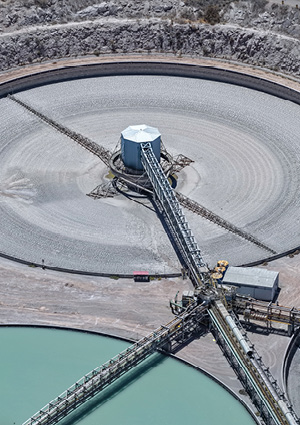
The underflow thickener pump formed a critical part of the tailings handling system, moving high-density slurry into the tailings transport system. The pump was operating at approximately 65 percent solids, where reliability is essential and interruptions can quickly become a production issue.
Before the retrofit, the pump used a traditional stuffing box packing arrangement. In this abrasive service, the shaft sleeve wore quickly, requiring replacement around every four months. While the impeller and rubber liners were typically replaced annually, sleeve change-outs were major maintenance events, taking around 36 hours, requiring a full mechanical crew across two shifts, and involving a 100-ton crane.
A mechanical seal package was designed to replace the original packing arrangement and retrofit onto the existing pump setup without modifications. The seal uses a controlled clean flush to maintain a cleaner environment at the sealing interface, with materials selected for abrasion tolerance in demanding slurry service.
After commissioning, the site saw a significant reduction in clean sealing-water demand. Under the operating conditions at the time, the change equated to around 288,000 liters per day less clean water used for sealing. For operations where water availability, treatment effort or cost are rising constraints, this shows how targeted upgrades can support sustainability and operational resilience.
The retrofit was also designed to align maintenance with the site’s planned annual major service interval, when the impeller and liners are replaced, reducing the need for additional intrusive interventions across the year.
What’s next for operators
The optimum sealing arrangement depends on factors including slurry concentration, pressure, shaft speed, water availability, and maintenance strategy, but many existing packed pumps present opportunities for retrofit where operating conditions are suitable.
It’s important to bear in mind that not every site will see the same numbers. However, sealing strategy is a realistic place to reduce water use and maintenance exposure in abrasive slurry duties, without redesigning the whole circuit.
It is critical to consider where clean water is being used continuously for sealing, and whether the flow rate is justified by the duty. It is also worth addressing whether the current sealing arrangement drives frequent intrusive work, particularly heavy lifts or long interventions. Where upgrades can be implemented through retrofit, reliability improvements need not depend on major pump replacement projects.
Mining’s decarbonization and resilience agenda is closely tied to how efficiently sites run their core processes. Whilst abrasive slurry duties will not always be the most visible part of that conversation, they sit on a critical path for tailings handling and can carry a large share of water use and maintenance risk.
For many operations, improving sealing performance is a practical step that supports lower clean-water demand, more predictable maintenance, and safer execution on production-critical assets.
Warren Smith
www.johncrane.com
Warren Smith is Global Mining Market Director at John Crane, where he draws on more than two decades of engineering and leadership experience to improve operational performance, strengthen strategic partnerships, and support customers across the global mining sector.